IRAMIS | CIMAP | LPS | LSI | SCM | SPAM | SPCSI | SPEC | webmail : intra - extra   |  Accès VPN-SSL |   
Laboratoire Léon Brillouin
UMR12 CEA-CNRS
Bât. 563 CEA Saclay
91191 Gif sur Yvette Cedex
France
llb-sec@cea.fr
 / 
 / 
 / 
English
drapeau 
« Domaines Techniques


Neutrons 
logo_tutelle logo_tutelle 

Les neutrons permettent de sonder la matière et leur sensibilité aux éléments légers et au magnétisme en font une sonde unique et originale. Au DRECAM, l’utilisation de la spectrométrie neutronique dans divers domaines de la recherche fondamentale et appliquée est développée autour du Laboratoire mixte CEA-CNRS Léon Brillouin autour du réacteur Orphée à Saclay. Ils sont principalement destinés à l'étude de la matière condensée. L'activité scientifique propre du laboratoire peut se regrouper en trois secteurs sensiblement d'égale importance: la physico-chimie, les études structurales et de transition de phases, le magnétisme et la supraconductivité.

Les réacteurs Orphée (LLB) et Osiris du Centre de Saclay sont aussi des sources de neutrons utilisées pour activer des échantillons qui sont ensuite analysés par spectrométrie γ (voir Analyse par Activation Neutronique Instrumentale).


maj : 12-09-2012 (110)


Voir aussi

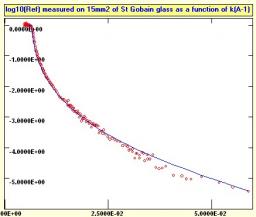
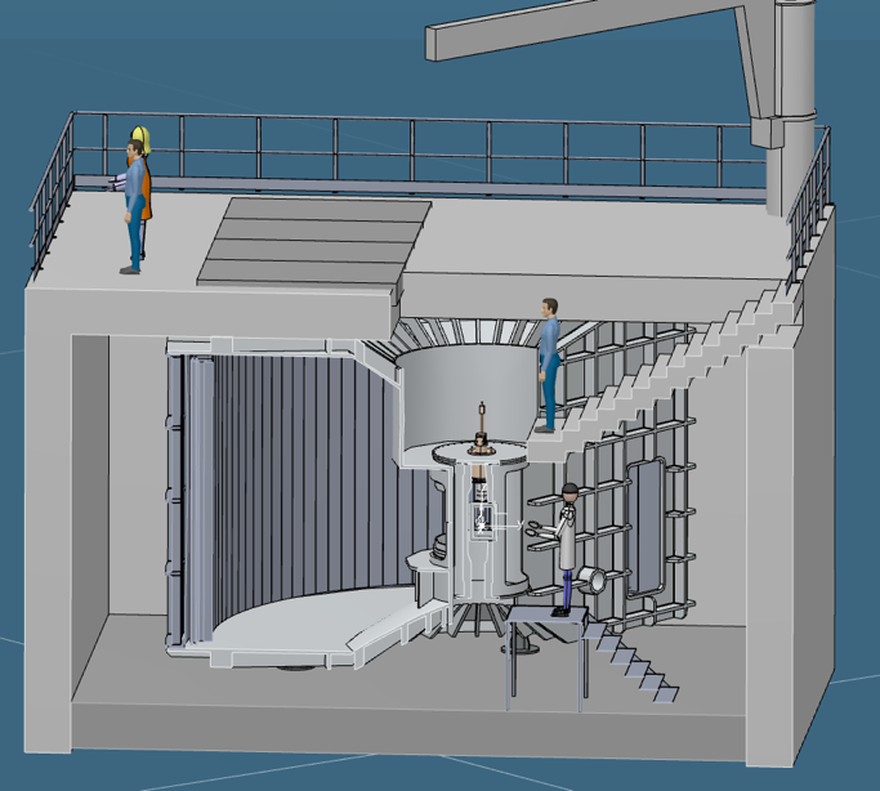
A reflectivity lower than 10-5 measured on a 15mm2 sample on Eros
Eros a versatile reflectometer
Reflectivity experiments have been performed on the Eros reflectometer at Saclay on very small pieces of glass. During this measurement, we did demonstrate our ability to obtain reflectivity curves down to values of 10-5 within a few hours. The curve obtain in this measurement is given ... Lire la suite »
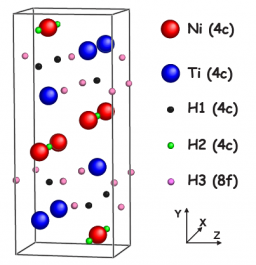
Cristallographic structures of austenitic and martensitic hydrides of Ti0.64Zr0.36Ni intermetallic compound
TiNi alloy is polymorphic. It exhibits a martensitic transition near room temperature between a cubic CsCl-type (austenite) and a monoclinic TiNi-type (martensite) structure. This transformation is at the origin of its shape memory effect. In addition, TiNi has good hydrogen storage properties ... Lire la suite »
Anisotropic reinforcement of nanocomposites tuned by by magnetic orientation of the filler network.
The improvement of the mechanical properties of polymer films by inclusion of mineral particles is a well known industrial practice used since the end of the XIX century. A classical example is the rubber industry for which the addition of carbon black as fillers permits to increase the elastic ... Lire la suite »
Control of roughness at interfaces and the impact on charge mobility in all-polymer field-effect transistors.
Using conjugated polymers as the active materials in electronic and optoelectronic devices opens up the possibility of fabricating all-polymer devices using solution processing technologies. The fabrication of good quality field-effect transistors (FETs) is crucial to a number of polymer-based ... Lire la suite »
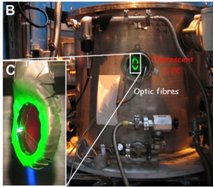
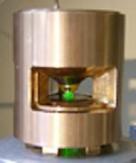
Coupling of laser excitation and inelastic neutron scattering measurement.
Light-harvesting antennae are pigment-protein complexes involved in light-absorption and excitation energy transfer (EET) to the so-called "reaction center" complexes, where the photochemical processes of photosynthesis take place. C-phycocyanin (C-PC) is one component of the phycobilisome, the ... Lire la suite »
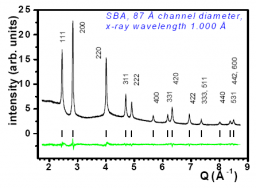
Diffraction studies of MnO confined in nanochannels os mesoporous matrices
I.V. Golosovsky1, I. Mirebeau2, G. André2, D. A. Kurdyukov3, Yu. A. Kumzerov3,
1: St. Petersburg Nuclear Physics Institute, 188350, Gatchina, St. Petersburg, Russia 2: Laboratoire Léon Brillouin, CE-Saclay, F-91191, Gif-sur-Yvette, France 3: A. F. Ioffe Physico-Technical Institute, 194021, St. Petersburg, Russia 4: Rostov State University, 344090, Rostov/Don, ... Lire la suite »
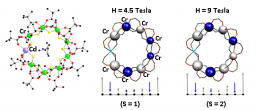
Effet de taille quantique dans une chaîne antiferromagnétique finie de spins 3/2
Les nanoaimants moléculaires forment des systèmes magnétiques discrets isolés, composés d’un nombre fini d’atomes magnétiques, qui présentent donc des effets quantiques par rapport aux systèmes classiques de dimension infinie. ... Lire la suite »
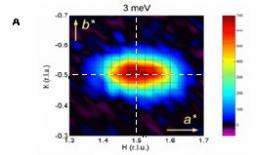
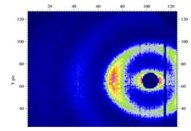
Electronic liquid crystal state in high temperature superconductor YBa2Cu3O6.45
The strongly interacting conduction electrons can be accurately represented as a gas of weakly interacting electron-like excitations. This description, known as Fermi liquid theory, works for many metallic systems. However, over the past two decades, new types of metallic materials with strongly ... Lire la suite »
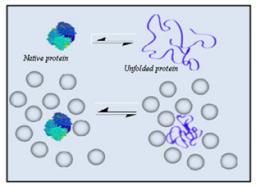
Influence of macromolecular crowding on protein stability.
Following the synthesis by the ribosome, to carry out its biological function, a protein much fold into a single, well defined conformational state: the native state. Protein folding is thus the physico-chemical process by which a polypeptidic chain undergoes a structural change from an ensemble of ... Lire la suite »
Influence of the alteration layer morphology on the silicate glass corrosion mechanism : role of Ca and Zr
This study investigates the long term behavior of glasses used for confinement of nuclear wastes. The results have been obtained from a fruitful collaboration between different CEA laboratories (LLB, LIONS, CEA Marcoule) and the Ecole Polytechnique. The corrosion process of the glasses by water ... Lire la suite »
Magnetoelectric coupling in BiFeO3 single cristals and thin films
BiFeO3 is a multiferroic materials in which ferroelectric and anti-ferromagnetic orders coexist well above room temperature (TN=643 K, TC=1093 K), with a high polarization (over 100 μC/cm2 [1]). We have shown at the LLB by neutron diffraction that these two order parameters interact and that the ... Lire la suite »
Mélanges catanioniques
Les systèmes catanioniques sont des mélanges de tensioactifs cationiques et anioniques. Nous nous focalisons plus particulièrement sur les vésicules catanioniques où la bicouche est à l'état solide ("phase gel"). Elles permettent ... Lire la suite »
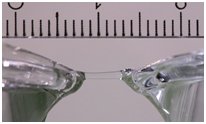
Neutrons and water structure: the heavy water bridge.
In 1893 Sir William Armstrong reported a remarkable experiment: if a high voltage is established between two wine-glasses filled to the brim with pure water and connected by a cotton  thread, a rope of water is formed and remains suspended between the lips of the two glasses. This "water ... Lire la suite »
Pressure induced ferromagnetic spin glass transition in the geometrically frustrated pyrochlore (Tb1-x Lax)2Mo2O7
  In the pyrochlore compounds R2Mo2O7, both rare earth R3+ and M4+ transition metal ions form a threedimensional network of corner sharing tetrahedra. The pyrochlore lattice is geometrically frustrated both for antiferromagnetic (AF) and ferromagnetic (F) nearestneighbour exchange ... Lire la suite »
Production d'éléments radioactifs
C. BETTONI
Le Groupe d’Analyse Elémentaire, au sein du Laboratoire Pierre Süe est relié à deux réacteurs nucléaires et produit, en plus du diagnostic élémentaire, des éléments radioactifs par activation pour des laboratoires de ... Lire la suite »
Self assembly of fatty acids in aqueous solutions.
The use of agricultural resources for industrial purposes will undoubtly be one of the major challenges of the 21 st century. Organic biosynthons used in chemistry should progressively replace those coming from fossil fuels. Our work on dispersions of fatty acids and hydroxylated derivatives forms ... Lire la suite »
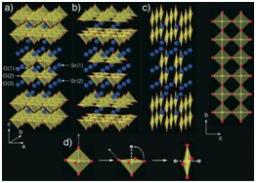
Spin ladder iron oxide : Sr3Fe2O5
The concept of "spin ladder" originally appeared to study the theoretically still controversial antiferromagnet (AF) 2D square lattice in high temperature superconducting cuprates starting from a well understood 1D AF chain [1-2]. They can been schematized as an array of finite number of coupled ... Lire la suite »
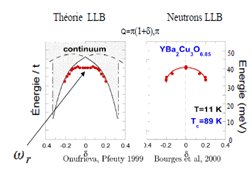
Superconducting pairing and electronic anomalies induced by the spin collective mode in HTC superconductors.
This work is part of a theoretical project which aims to unravel the mechanism at work in the high temperature cuprate superconductors. In the recent article [1] we have studied the role of spin fluctuations, and namely of the collective spin mode, for the superconducting pairing and numerous ... Lire la suite »
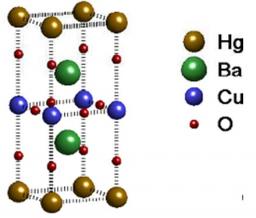
Unusual magnetic order in the pseudogap region of the superconductor HgBa2CuO4+δ
The pseudogap region of the phase diagram is an important unsolved puzzle in the field of hightransition-temperature (Tc) superconductivity, characterized by anomalous physical properties below a certain temperature, T*[1]. In contrast to the superconducting temperature Tc which exhibits a ... Lire la suite »